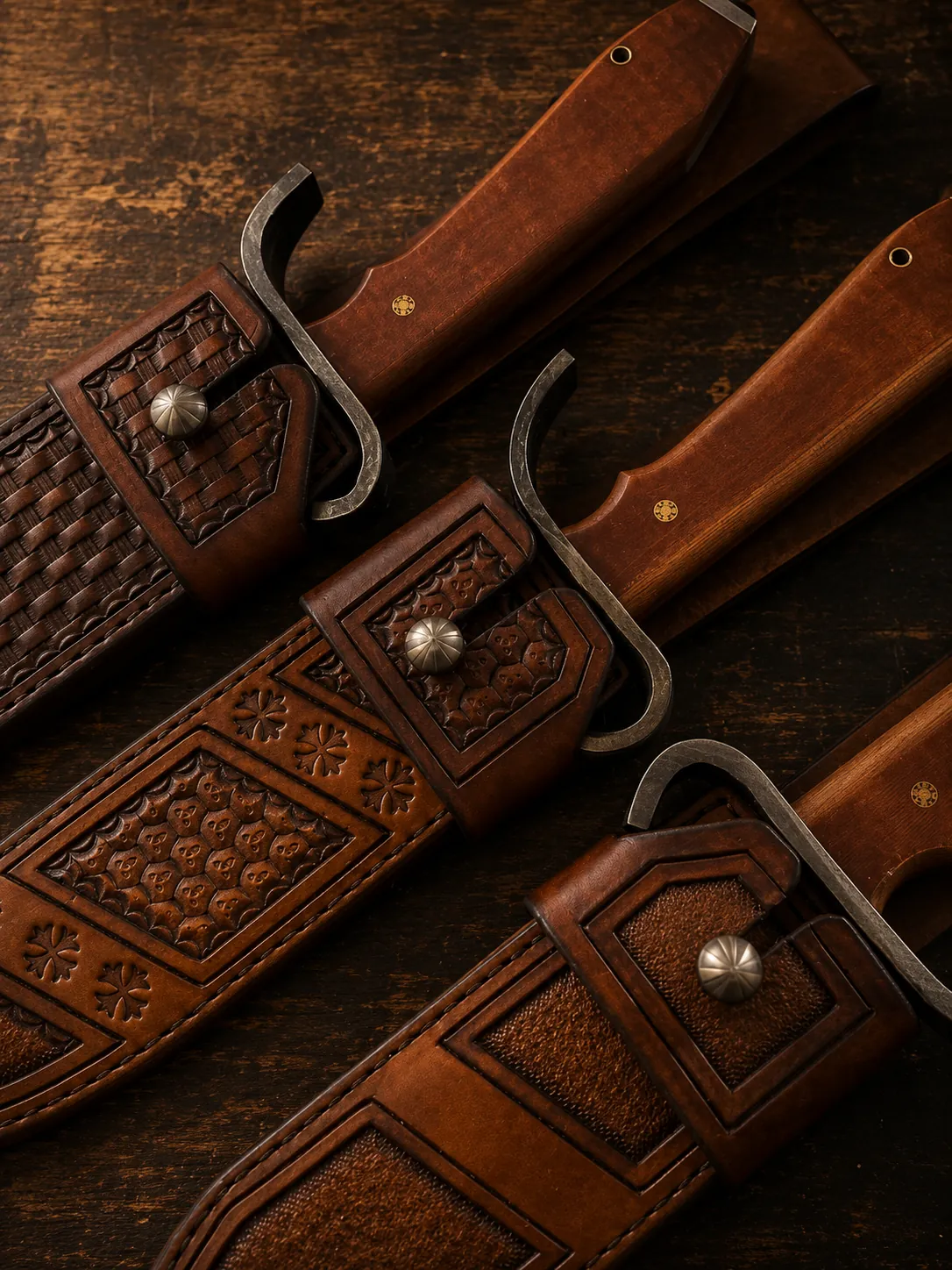
A knife sheath looks simple — a folded piece of leather with a snap. It isn't. It is a safety device you wear against your body, and the details that keep a blade where it belongs are all on the inside.
The welt is everything
Between the two faces of a good sheath runs a welt — a strip of leather the stitches pass through, so the thread never touches the edge of the blade. Without it, a sharp knife slices the stitching from the inside on the first hard draw. The welt is the difference between a sheath that lasts a lifetime and one that fails in a season.
Wet-molded to the blade
A custom sheath is wet-molded — soaked, wrapped tight around the specific knife it will hold, and left to dry into its final shape. Once cured, the leather remembers that blade forever. It grips it just enough to hold it in place, and releases cleanly on the draw.
Retention is a design choice
Sheaths off a shelf are built to fit a range of knives, so they fit none of them well. A custom sheath is built for one knife, with the retention tuned for how you carry — belt, boot, pack. It comes out when you want it, and never when you don't.
A sheath is a safety device. Build it like one.
If your knife matters, its sheath should be made for it.
Want a piece made for you?
Every commission is one of a kind — hand-tooled, and made to order.
Commission a Piece