
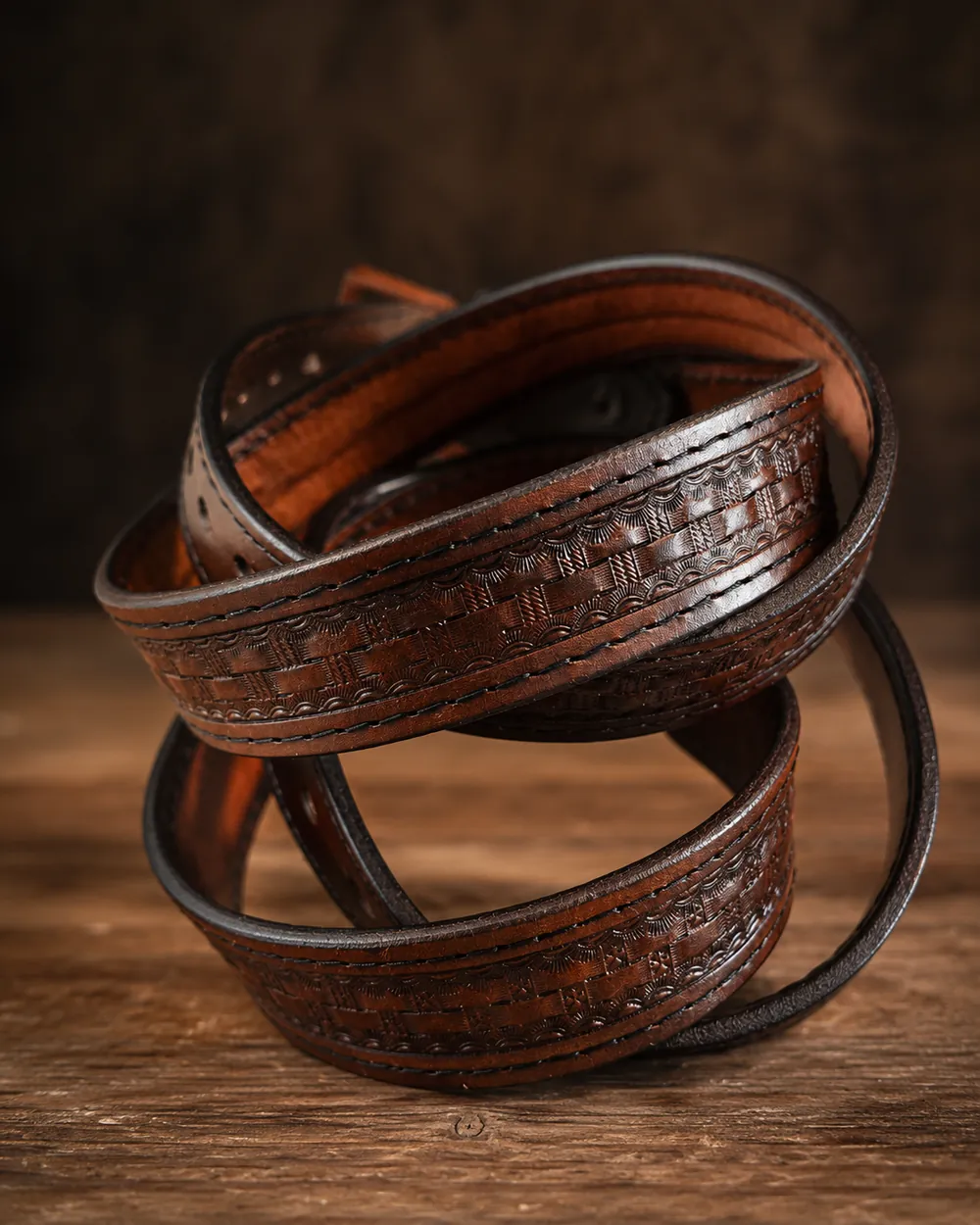
A belt is the piece of leather you handle most and think about least. A store-bought one is a folded, glued strip of split leather with a plated buckle, and it collapses within a couple of years. A custom belt is a single cut of full-grain veg-tan sized to your body, and it usually outlasts the trousers it was bought for. Here is everything you will be asked when you order one.
Measuring correctly
Belt sizing is the single most common ordering mistake. Your trouser waist size is not your belt size, and jeans-tag numbers are close to fiction.
- Best method: take a belt you already wear, lay it flat, and measure from the fold at the buckle end to the hole you actually use. That number, in inches, is your belt size.
- No belt to hand: run a soft tape through your belt loops over the trousers you will wear it with, pulled comfortably snug, and use that measurement.
- Do not add or subtract anything. A good maker cuts the strap so your stated size lands on the centre hole, leaving two holes of adjustment each way.
Tell the maker if the belt will carry weight — a holster or a heavy tool pouch rides differently and often wants a half-inch of extra length.
Leather weight and width
Weight is thickness: one ounce is about 1/64 inch. Width is measured across the strap and must match your belt loops.
- 6–7 oz, 1 to 1.25 in — dress belts. Slim, flexible, sits neatly under a jacket.
- 8–9 oz, 1.5 in — the everyday standard. Stiff enough to hold shape, comfortable all day, ideal for tooling.
- 10–12 oz, or two layers stitched back to back, 1.5 to 1.75 in — work and gun belts. Almost no vertical roll under load.
Most dress trousers take a 1.25 in strap; jeans and work trousers take 1.5 in. Measure your narrowest belt loop before deciding.
Construction details that decide the lifespan
- Single-ply full-grain, not folded. A folded-and-glued belt fails along the glue line. One solid cut cannot.
- Hand saddle-stitched keeper and buckle fold. Two needles, one thread, locking every stitch — if one loop is cut the rest hold.
- Chicago screws or copper rivets at the buckle fold, so the buckle can be swapped later without destroying the strap.
- Burnished edges. Slicked and waxed edges shed water and stop the fibre from fraying. A raw or painted edge is a shortcut.
- Lining. Optional. A thin lining hides the flesh side and adds body, at the cost of some flexibility.
Buckles
Buckle width must match strap width exactly. Beyond that:
- Solid brass — warm colour, ages to a soft patina, effectively permanent.
- Stainless steel — cool grey, will not tarnish, best around salt water.
- Nickel-plated — inexpensive, and the plating eventually flakes. Fine on a dress belt, not on a work belt.
- Trophy and ranger buckles — need a specific billet width; say so early, because the strap is cut to suit.
Tooling and personalisation
The strap is a long, flat, highly visible canvas, which makes it the best surface in leatherwork for carved decoration. Common choices from this bench:
- Basketweave — the classic. It hardens the surface as it is stamped and hides scuffs better than any other pattern. There is a longer note on why in the journal.
- Floral and Sheridan carving — the most work, and the most striking.
- Border-only tooling — a restrained line down each edge, good under a suit.
- Name, brand or initials — hand-stamped on the back or tooled into the tail.
Dye choice matters too: natural veg-tan left undyed will darken on its own over a year or two into a colour no dye reproduces.
What to send when you commission
Your measured belt size, the strap width your loops accept, intended use (dress, daily, work, gun belt), buckle preference, and any tooling pattern or reference photos. Colour last — it is the easiest thing to change and the least important to the finished piece's life.
Timelines, pricing and the current queue are on the commissions page, or you can start a conversation with a rough description and we will work the details out from there.

Want a piece made for you?
Every commission is one of a kind — hand-tooled, and made to order.
Commission a Piece