
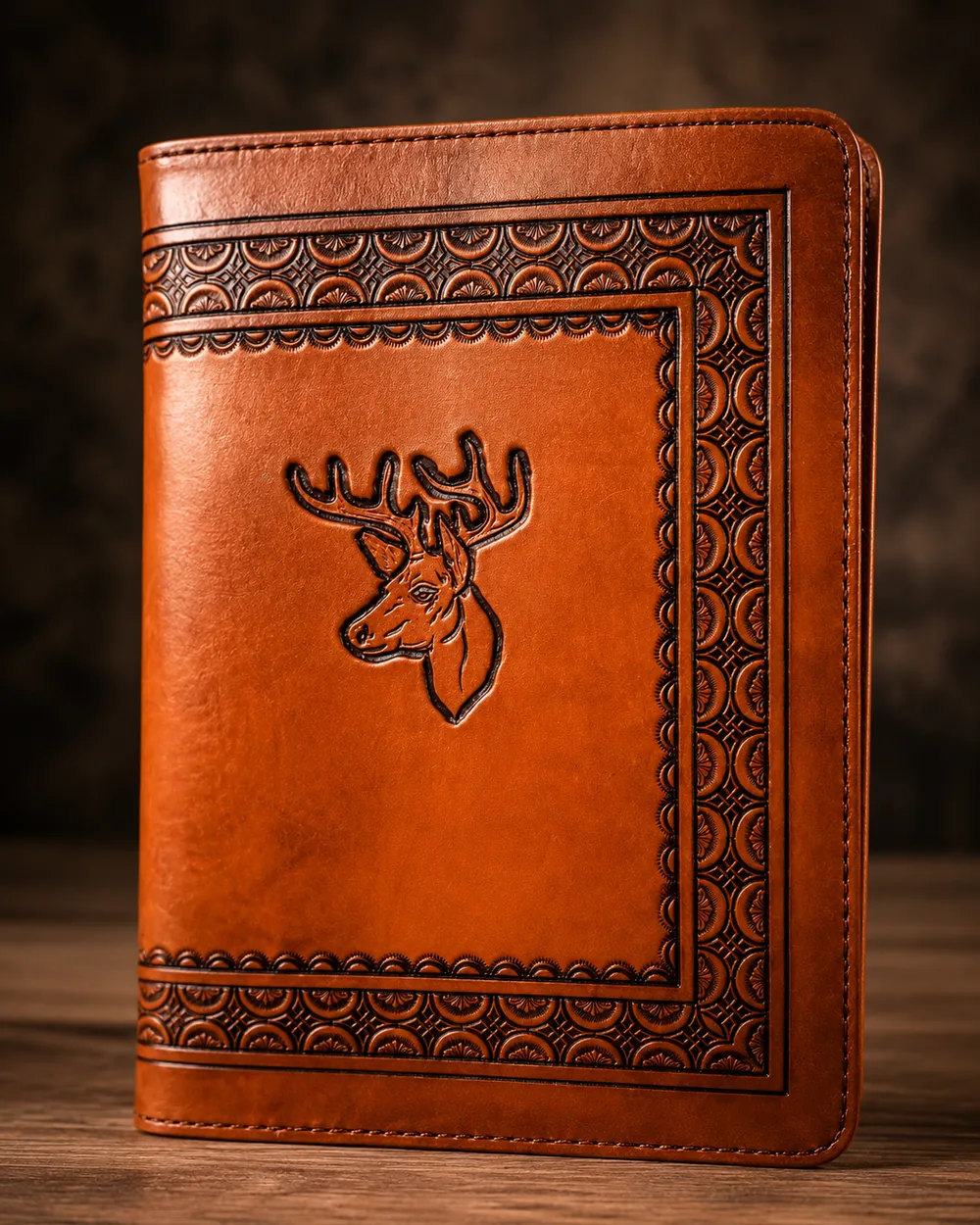
"Genuine leather" sounds like a guarantee. It is closer to the opposite. The grading words stamped on wallets, belts and bags describe how much of the hide's original surface survived processing — and that single fact predicts how the piece will age better than price, brand or colour ever will.
How a hide is split
A tanned hide is thicker than most finished goods need, so it is sliced horizontally into layers. The top layer carries the grain: the dense, tightly packed fibre surface that grew closest to the animal's hair. Everything below it is looser, weaker corium. Every grade name below is really a statement about how much of that top layer is left.
- Full-grain. The whole top layer, untouched. Pores, healed scars, insect marks and range brands are all still visible. Strongest fibre structure available, and the only grade that develops a real patina.
- Top-grain. The top layer with its surface sanded off to remove blemishes, usually followed by an embossed fake grain and a pigment coat. Smoother and more uniform than full-grain, but the strongest fibres have literally been sanded away.
- Genuine leather. A marketing term for the lower splits. Real leather in the legal sense, weak in the practical one. Almost always coated or embossed to imitate a grain it does not have.
- Bonded leather. Leather scrap ground up, mixed with adhesive and rolled into sheets with a polyurethane skin. It delaminates. Avoid it entirely.
Tanning matters as much as grade
Grade tells you which part of the hide you have. Tanning tells you what it can do.
- Vegetable-tanned leather is cured with tannins from bark and plant matter over weeks. It takes a tooling stamp, holds a wet-molded shape, darkens beautifully with sun and oil, and is what every piece on this bench is cut from.
- Chrome-tanned leather is cured in chromium salts in about a day. Soft, colour-fast and cheap — good for garments and upholstery, useless for tooling, and its residual salts are unkind to a carbon-steel blade kept against them.
A full-grain chrome-tanned hide and a full-grain veg-tanned hide are both full-grain, and they behave nothing alike. Ask for both words.
Telling them apart with your hands
You rarely get a spec sheet, so use the piece itself:
- Look at the edge. A cut edge on full-grain shows a dense, fibrous cross-section with no plastic skin. A painted-looking film at the surface means a coating over a split.
- Read the surface. Perfectly uniform pores in a repeating pattern are embossed. Real grain wanders; no two square inches match.
- Press a fold. Full-grain wrinkles into fine irregular lines that relax. Coated splits crease sharply and hold the crease.
- Smell it. Veg-tan smells sweet and woody. A chemical or vinyl smell is a finish, not a hide.
- Check the back. A fuzzy suede-like flesh side is normal. A woven fabric backing means bonded or split-and-laminated material.
Which grade for which job
- Belts, sheaths, holsters, straps. Full-grain vegetable-tanned, 8–10 oz. These carry load and take abrasion; nothing else survives it.
- Tooled and carved work. Full-grain veg-tan only. A stamp needs live fibre to compress against; coated leather just dents and springs back.
- Book and journal covers. Full-grain veg-tan in 4–6 oz for tooling, or a supple chrome-tanned goat lining inside it.
- Garments and soft bags. Chrome-tanned lamb, goat or calf — drape matters more than fibre strength here.
What "it will last a lifetime" actually requires
Grade is necessary but not sufficient. A full-grain belt with a skived, glued-and-folded joint fails at the joint. A full-grain sheath sewn with machine lockstitch unravels the moment one thread parts. Longevity is the product of three things together: full-grain veg-tanned leather, hand saddle-stitching that cannot unzip, and hardware — buckles, rivets, snaps — in solid brass or stainless rather than plated pot metal.
That is the standard everything leaving this bench is built to. If you are weighing up a commission, the knife sheath design guide walks through the same decisions applied to one specific piece, and the commissions page covers timelines and pricing.
Quick reference
- Best for hard-wearing custom work: full-grain, vegetable-tanned.
- Acceptable for soft goods: top-grain or full-grain chrome-tanned.
- Buy with caution: anything labelled only "genuine leather".
- Do not buy: bonded leather.
Want a piece made for you?
Every commission is one of a kind — hand-tooled, and made to order.
Commission a Piece