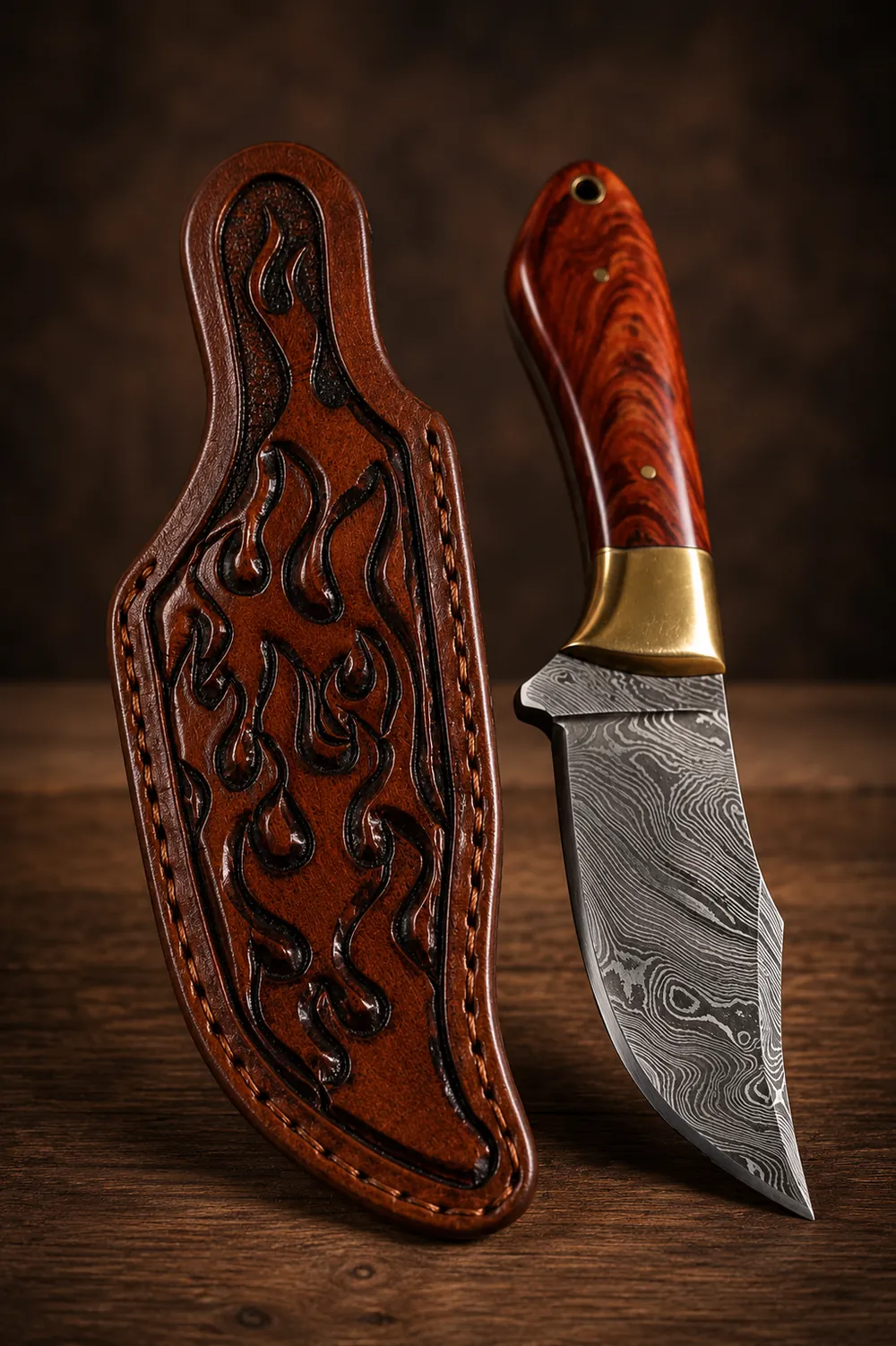
A sheath off the rack is built to fit a range of knives, which means it fits none of them properly. A custom leather knife sheath is built around one blade, for one person, for one way of carrying. This guide walks through every decision you will be asked to make when you commission one — and what each choice actually changes in use.
Start with how you carry
Every other decision follows from this one. The same knife wants a different sheath depending on whether it rides on a belt all day, lives in a pack, or sits in a display case.
- Vertical belt carry. The default. The sheath hangs from a belt loop and draws straight up. Best for working knives you reach for often.
- Horizontal / scout carry. The sheath lies flat across the small of the back or the front of the belt. Comfortable when seated or driving, and the knife stays out of the way of a pack's hip belt.
- Cross-draw. Angled on the opposite hip. Favoured for longer blades and for anyone who works kneeling.
- Pouch or dangler. A separate loop lets the sheath swing and sit below the belt line — easier to reach over layered clothing.
- Boot and neck carry. Small blades only, and retention becomes the critical detail rather than a convenience.
Leather weight and why it matters
Leather is measured in ounces, where one ounce is roughly 1/64 of an inch of thickness. For sheaths, the working range is narrow:
- 6–7 oz — light folding-knife pouches and small neck sheaths. Flexible, low bulk.
- 8–9 oz — the standard for most fixed-blade belt sheaths. Stiff enough to hold a wet-molded shape, thin enough to tool cleanly.
- 10 oz and up — heavy field and camp knives, or any sheath that will take real abuse. Harder to tool in fine detail.
Vegetable-tanned leather is the only sensible choice for a tooled sheath. It takes a stamp, holds a wet-molded shape, and darkens with age. Chrome-tanned leather does none of those things, and the salts used in chrome tanning are unkind to a carbon-steel blade over time.
The welt is not optional
Between the two faces of a sheath runs a welt — a strip of leather the stitching passes through, so the thread never sits against the cutting edge. Without a welt, a sharp knife slices its own stitching from the inside, usually on a hard draw. Any sheath quoted without one is not a sheath; it is a folded piece of leather.
A sheath is a safety device. Build it like one.
Wet-molding and retention
A custom sheath is soaked, formed tight around the specific knife it will hold, and left to cure into that shape. Once dry, the leather remembers the blade permanently: it grips the handle or guard just hard enough to hold the knife through a day of movement, and releases cleanly when you want it.
Retention is a design choice, not a happy accident. Tell the maker how you carry — a knife that rides in a pack can be looser than one worn while climbing a ladder. Molding alone is often enough for a guarded blade; a retention strap is added when the carry position is aggressive or the handle offers nothing to grip.
Tooling patterns
Tooling is where a custom sheath stops being hardware and starts being yours. The three families worth knowing:
- Basketweave. Repeating stamped weave across the whole face. It work-hardens the surface and hides scuffs better than anything else, which is why it has covered saddles, holsters and duty gear for a century.
- Floral and Sheridan carving. Swivel-knife cuts, then beveled and shaded by hand. The most labour-intensive option and the most striking.
- Border and geometric stamping. A clean line around the edge, sometimes with a repeating motif. Understated, and the quickest route to a finished look.
Names, dates, initials, unit crests and maker's marks can all be worked in. Say so early — lettering has to be planned into the layout before the first cut.
Stitching, edges and finish
Seams should be saddle-stitched by hand: two needles, one thread, each hole locked from both sides. A machine lock-stitch runs faster but unravels along its whole length once a single stitch is cut. A hand-stitched seam that takes damage stays put.
Edges are bevelled, burnished and sealed so they shed water rather than wick it. Dye and finish choice affects durability as much as looks — an oiled finish feeds the leather and ages warm, while a heavier top coat resists water at the cost of some patina.
Hardware
Solid brass, nickel-plated brass and stainless are the sensible choices for snaps, rivets and D-rings. Plated pot metal is what fails first on a cheap sheath. If the knife will see salt air or salt water, say so — it changes the hardware specification.
What to send the maker
A sheath can only be built as accurately as the information behind it. Send:
- The knife itself where possible — it is wet-molded around the real blade.
- If shipping the knife is not an option: a flat, square-on photograph on a plain background with a ruler in frame, plus blade length, blade width at the widest point, spine thickness, and overall length.
- Your belt width — 1.25" and 1.5" are the common ones, and a loop cut for the wrong width will flop or will not thread at all.
- Which side you carry on, and which carry style from the list above.
- Any lettering, crest or pattern reference, and a colour direction.
Cost and lead time
Two things drive the price of a custom sheath: hours of hand tooling and the complexity of the molding. A clean bordered sheath is a fraction of the work of a fully carved floral one, and the difference shows in both the quote and the calendar. Every piece here is made to order, one at a time — the schedule depends on what is already on the bench, so ask early if the sheath is a gift with a date attached.
Caring for it
Keep the sheath dry when you can, and let it dry slowly and away from heat when you cannot — direct heat cooks the fibres and makes leather brittle. Feed it lightly with a leather conditioner once or twice a year. Never store a carbon-steel blade in a damp sheath for long periods; leather holds moisture against steel.
Commission one
If you want the mechanical detail behind these choices, read The Anatomy of a Custom Knife Sheath and Why Basketweave Wears Better Than Anything. When you are ready to build one around your blade, start a commission — send the measurements above and we will work out the rest together.
Want a piece made for you?
Every commission is one of a kind — hand-tooled, and made to order.
Commission a Piece